
Trust is Local: An Interview with Bobbie Laur
How higher ed can (finally) beat the "ivory tower" allegations

Pick almost any phrase used to describe higher education’s relationship with the people who live around it. Odds are it isn’t a compliment. The ivory tower. The town-gown divide. The college bubble. Each of those phrases invoke distance. None of them describe a relationship.
Change can and should start locally. Trust in higher education has cratered over the past decade, but almost 80% of Americans still believe colleges can make a real difference right where they are, in their own communities.
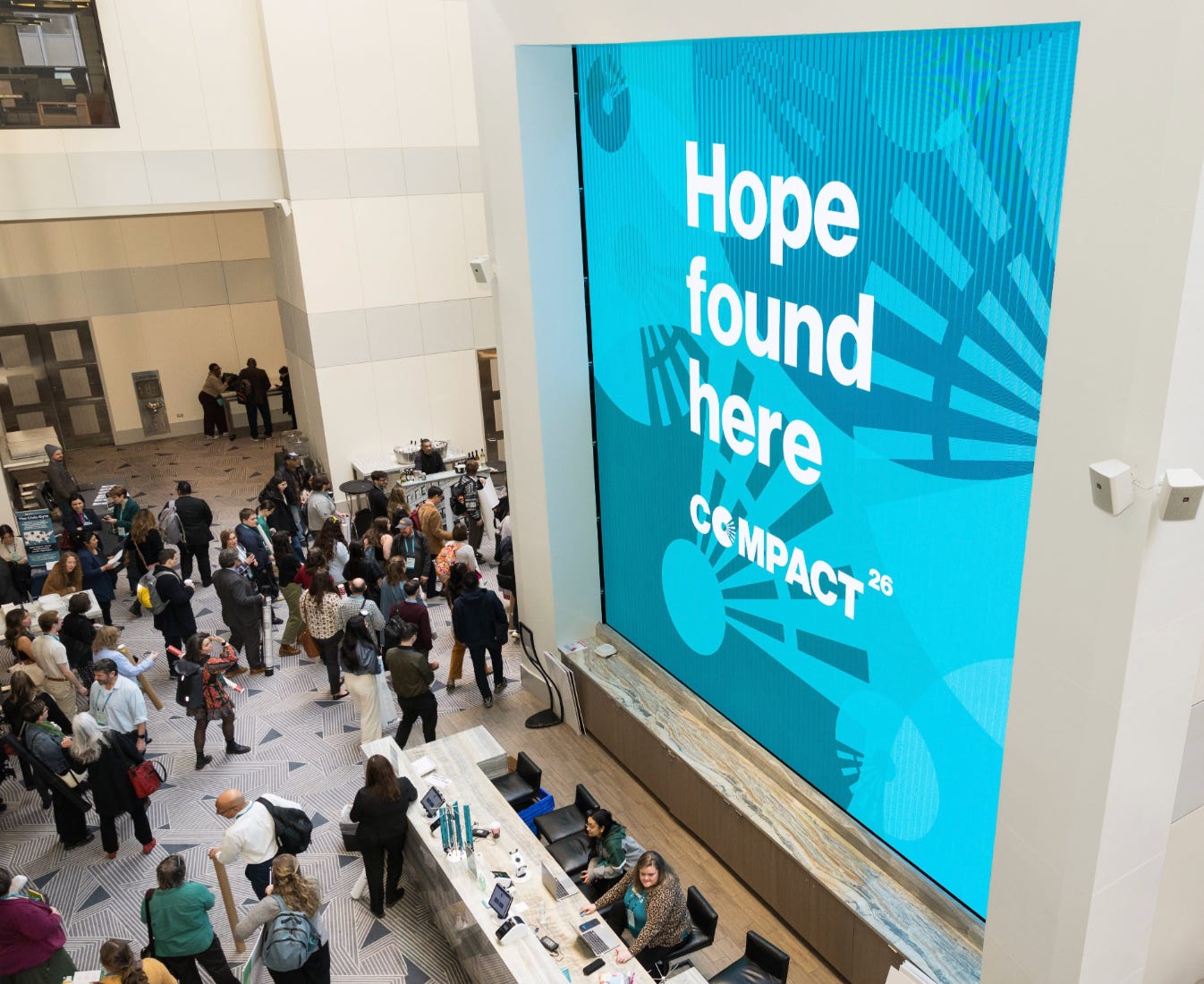
When the APT team wrote The Trust Agenda, we quickly realized that community engagement would be a core pillar of our recommendations. Bobbie Laur, president of Campus Compact, a coalition of colleges and universities seeking to build durable relationships with their communities, has shaped how we think about this more than almost anyone we’ve talked to.
I recently asked Laur how institutions can build trust with the communities around them, how they can educate engaged citizens when technology and the cost-of-living crisis give people every reason to check out, and how campus leaders can keep their eyes on the long game while higher ed is on fire. Our conversation has been edited for length and clarity.
For readers who may not be familiar with Campus Compact, what should they know about the organization and the work you do?
I’ll tie this into one of The Trust Agenda report’s core findings. Deepening commitments to community engagement is one of the most important things campuses can do right now to rebuild trust. Campus Compact exists to support institutions holistically in doing exactly that.
That support takes a few forms. First, institutional strategy. We help campuses figure out how community engagement gets embedded so it’s not just a signature initiative, but something core to how the institution actually operates. Second, professional development. We support the faculty, staff, and administrators who do this work, at every stage of their careers. Third, student leadership. We’re always thinking about how students can be co-designers and co-creators of this work, not just recipients of it. And finally, we work to drive effective practice. We want to help campuses understand who’s doing what well, how it’s being measured and communicated, and making sure institutions have the tools and use cases to put it into action.
Campus Compact was founded in 1985 by the Presidents of Georgetown, Stanford, and Brown Universities, but today our membership is incredibly diverse. We work with campuses of every shape and size, because community engagement is critical for every type of college and university. However, context does matter and can mean the work manifests differently depending on geography, institutional type, and student body.
You’ve described community engagement as a “trust infrastructure” for institutions, even as many communities have real reasons to distrust the institutions in their midst. What can a campus actually do to earn that trust and who within an institution should lead that work?
Infrastructure isn’t built overnight. It has to be resourced, and it takes time we don’t always feel like we have. People want a quick fix on trust, but trust is built by showing up, by listening, by not always saying yes but having a mentality of yes, and by not creating unfulfilled promises. One of our presidents, from UT Arlington, wrote about this well. Campuses should try to say yes to their communities, but making sure you don’t overpromise matters just as much.
When things go right (or wrong), you can’t manufacture a relationship in that moment if one doesn’t already exist. Community engagement professionals are the people who’ve spent years making sure the community’s perspective is considered and prioritized. These leaders are often scholar-administrators and have deep experience both in the academic core and in externally-focused work. They’re working to advance everything from community engaged research partnerships to economic development partnerships that focus on bringing jobs to local neighborhoods. They are trusted communicators because they’ve the regulars at community meetings, their partners know and trust them, and because they’ve delivered and helped to solve problems that can hinder campuses and communities operating together.
It’s also increasingly important that campuses integrate community and civic engagement at the senior leadership level. For instance, we are seeing a significant growth in Chief Engagement Officer roles at the cabinet level.
Campuses that understand this also understand that effective community engagement requires real resources, the same way supporting student mental health does. You can’t just talk about being community-engaged as a strategy or a talking point. You have to build it into the institution’s structure.
Many campus leaders hear “community engagement” and picture service activities like volunteering, food drives, and alternative spring breaks. How does reciprocal engagement differ from service, and what does the path from one to the other look like?
One thing we have to be careful about is treating service and engagement as opposites. Transactional outreach or service is often a building block toward something deeper, not the opposite of it.
Take a K-12 school that calls a local university and asks for student mentors for kids exploring college. That’s a service activity. But saying yes to it builds a relationship, because the school sees the university as a good partner. Showing up and delivering on small things is how you build trust. At my alma mater, Towson University, for instance, a history of holistically and responsively supporting the K-12 community across the state has built trust between the community and the university. Those projects and partnerships work can lead to transformational impact.
One example is the TU Baltimore County Model UN program. This is a partnership between Towson University and Baltimore County Public Schools that has reimagined Model UN to create an accessible and equitable program that provides hands on civic learning and experience for high schoolers and TU students alike. This incredible program is led by the Dean of TU’s Honors College, Alison McCartney, and has been in operation for over 20 years.
You don’t build a reciprocal, transformational partnership like that overnight. It’s a journey. Campuses need to recognize that service and engagement are interconnected. And in practice, real reciprocity means recognizing that communities hold knowledge that universities don’t have. Understanding what a community or neighborhood has been through isn’t just useful information for the university, it’s critical to building better solutions going forward. That matters enormously right now, because higher education has to communicate—and live out—the role it plays for the much larger share of society that will never set foot on campus as a student.
You’ve talked about the need for institutions to actively leverage their economic power—be it through procurement, hiring, workforce development—to benefit their communities. How do you get campus leaders to acknowledge and apply that power without it becoming patronizing?
There’s hardly a college president in the country who can’t tell you the economic impact of their institution. It’s one of the few metrics nearly every president carries with them, usually built from spending, expenditures, jobs created, and incomes supported. Beyond those reports are rich opportunities for deeper work, focused on driving economic and societal impact, particularly at the hyperlocal level. Community engaged institutions are increasingly taking their economic impact a step further to better understand and consider how they positively impact the neighborhoods closest to their campus. For instance, what jobs are they supporting, what small businesses are they purchasing from?
Anchor economic work means asking what responsibility an institution has as a place-based institution, to make sure the people next door are benefiting from the institution and have opportunities to create life-sustaining wages. This is the kind of opportunity that can change a family’s trajectory for generations.
Procurement is one of the most powerful levers here, and there’s good, documented work, particularly from hospitals, on anchor purchasing. Small policy tweaks can make an outsized difference. For instance, negotiating with a contracted food service provider so that below a certain dollar threshold, departments can use a local vendor instead. Once that’s unlocked, every small event on campus can use the local bakery which changes businesses and lives. Being an anchor institution isn’t only about teaching and research; it’s also about how you hire and how you spend.
There’s a narrative tension in how campuses talk about producing civic-minded and community-engaged graduates even as many students—particularly at elite institutions—end up in finance, tech, or consulting. Given the pressures of student debt and cost of living, how do we cultivate community-engaged graduates when income often has to come first?
Affordability is one of the biggest critiques of higher education, and we need to keep demonstrating that college is a wise investment. Fortunately, the data is on our side. Most graduates—especially those educated at community colleges and regional public institutions—are fueling the workforce across the public and private sectors, including government, nonprofits, education, health care, entrepreneurship, and finance. They are not simply choosing between high-paying consulting jobs and low-paying public-service roles; they are becoming the teachers, nurses, business owners, financial experts, and civic leaders our communities need.
At the same time, we should take seriously the conversations happening at elite, high-cost institutions, where fewer graduates appear to be entering public-service careers. That trend matters, too, because public-sector leadership needs those graduates as well.
Today’s young people are passionate about making a difference and understanding the levers of change. They want to build skills for addressing the issues they care about. For instance, Campus Compact has a new fiscal leadership lab working with students interested in making a positive difference though their deep knowledge and understanding around fiscal policy change.
Ultimately, we must be preparing all students with necessary civic skills, like collaboration, leadership, and working across difference. Every single citizen needs these skills, and it’s essential not to assume that civic and community engagement is only important for students entering “mission driven” careers or public service. These are lifelong skills that are necessary for our communities and society to thrive.
We’re living through a moment when technology connects us globally while continuing to isolate us locally, and campuses are both products and producers of that dynamic. How can institutions, especially those drawing from national and international applicant pools, prepare students for a changing world without inadvertently training them to opt out of the communities around them?
In some ways, this is exactly the moment for community-engaged student experience to matter more than ever. Young people’s whole world is digitally grounded because that’s where the bulk of their social connection happens. There’s exciting work happening in digital community engagement, but most of what we’re talking about is fundamentally about humans working with humans in real life, and those opportunities are getting harder to come by even as people are hungry for that.
That’s part of why we’re seeing a real uptick in young faculty who come in actively wanting to teach in community-engaged ways. Their own collegiate and doctoral experience was grounded in community-based work, and that shapes how they want to teach.
I’m also doing some thinking right now about third spaces, and why they matter more than ever. We’ve seen a real diminishing of accessible third spaces in our communities—places without a barrier to entry where people can come together. Universities and colleges can be powerful activators of those spaces, creating both intentional and incidental opportunities for human connection. And that, too, is part of building trust. You have to build trust with people unlike yourself, and historically a lot of that has happened in third spaces.
Trust and reciprocal relationships take a long time to build, but higher education is under enormous pressure right now from many directions. How should leaders hold to that long game while still responding to what can feel like a constant game of whack-a-mole?
A few things. First, campuses need to connect the dots on what they’re already doing. Most institutions have a lot of community-engaged work happening, but without a clear asset-mapping process, neither the campus nor the community has a full picture of the institution’s actual impact. You can’t communicate effectively about something you haven’t fully mapped. Our Campus Action Planning framework and initiative is a great place to start.
Second, leaders have to be open to criticism and to having honest conversations with their communities. There are good structures for deep, sustained community dialogue that can position higher education not just as a stakeholder, but as a convener helping communities think about how to move forward together. This is a hard moment for trust across all public institutions, not just higher education, and we shouldn’t separate ourselves from that. If we want to claim a role as convener, we have to be willing to take criticism.
Third, this is not the moment to make deep cuts to community engagement, even with tight budgets. It’s a moment to invest more, not less. This work is genuinely fundable. There are real returns on value for students and communities alike. I’m not ignoring the very real, and in many cases dire, financial strain facing our institutions and communities, but community engaged leadership and work has always been resourceful and partner-oriented. This is a moment where creativity and collaboration are necessary, and this has always been a strength and a foundation of community engagement.
Any final thoughts?
We’re constantly asked how higher education contributes to democracy right now. I’d say that the ability to make a positive impact in a community is what democracy at work looks like. Helping communities, students, faculty, and staff understand how society can function for the betterment of all is how we move our democratic objectives forward. It’s how people regain trust, how they come to feel they have voice and agency, and how they can see themselves creating positive change. Community engagement is essential to making that real.
Community engagement, civic engagement, and democracy aren’t separate lanes, but they are distinct bodies of work. Doing all of them well takes real capacity and real strategy. That’s what we spend every day doing.